
Key elements of biocultural diversity – species, cultures, and languages – are being lost globally at an increasing rate. Inspired by the work of the nineteen Biosphere Region organizations in Canada who engage people and resources to protect what remains, my research explores connections between conservation and economic development to secure resilience and support sustainability. Together with people in Biosphere Regions, my goal is to help organizations develop practices for a growing abundance of biocultural diversity in the places where people live and work.
My research project bridges theory and practice – it enhances theoretical and practical understanding of organizing for a regenerative future. Ultimately, the goal is to understand how organizations in Biosphere Regions can engage in regenerative organizing – arranging ecological, social, and economic systems for adaptability and flourishing – to create lasting benefits for regional biocultural diversity.
The UNESCO Man and the Biosphere Programme – an intergovernmental program that seeks to establish a scientific basis for improving relationships between people and their environments – has been recognizing local efforts to convene organizational partnerships to conserve ecologically and culturally important landscapes since 1976. Internationally, different names have been adopted to reflect local culture, goals and legal frameworks - for example, “Biosphere Regions” in Canada and “UNESCO Eco-Parks” in Japan.
Entrepreneurship is the process of finding creative ways to use what already exists – skills, resources, and relationships – to develop new ideas or activities that create value. This process creates pathways – step-by-step routes toward a big goal that guide decisions and actions.
Value comes in many forms:
- Ecological (e.g., cleaner water, restored habitats, reduced pollution, improved soil health)
- Cultural (e.g., preservation of local traditions and languages, Indigenous knowledge sharing, celebrating community identity)
- Social (e.g., stronger community relationships and trust, shared decision-making and leadership, learning, improved well-being)
- Economic (e.g., sustainable livelihoods, fair incomes, local job creation, nature-positive enterprises and circular economy practices, new markets for regenerative products and services)
- Knowledge (e.g., shared learning, innovation, access to diverse ways of knowing, building capacity for future generations)
Value creates benefits that help people, communities, and nature thrive together.
Regenerative means people and nature thrive together, keep resources flowing in healthy cycles, and make things better over time instead of just keeping them the same.
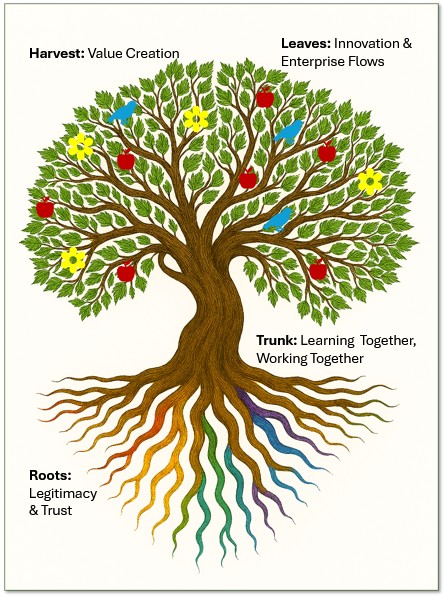
A tree can act as a metaphor for regenerative organizing and the practices involved. The initiatives of Biosphere Regions across Canada will be investigated using four lenses:
(1) Trust & Legitimacy – The first step toward working in more regenerative ways involves engaging diversity in all its forms to create trust and legitimacy (i.e. establishing good roots for the tree).
(2) Learning & Working Together – An initiative is an organized effort to solve a problem or seize an opportunity. Initiatives are the focus of my study because they enable practical steps toward a bigger vision and are expressions of learning and working together (i.e. investing in a strong trunk for the tree).
(3) Innovation & Enterprise – Exploring the activities, arrangements, and outcomes of initiatives paints a picture of the creative efforts that generate value for people, communities, and nature to thrive together. (i.e. are the leaves of the tree healthy enough to generate energy for the tree?)
(4) Value Creation – A tree generates value – a harvest of flowers, fruit, seeds, homes for wildlife, etc. that is shared. This makes a tree a good metaphor for regenerative organizing where the efficacy of sharing value created by initiatives is crucial.
The project involves three phases of data collection:
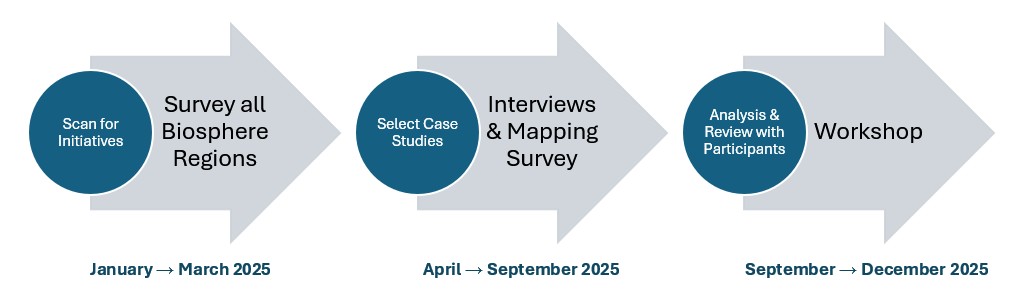
I will engage individual research participants in scrutinizing regenerative organizing activities through surveys, interviews, and a social learning workshop.
Learn more about my research approach.
Contact the researchers to learn more about this project.
Student Researcher:
Brenda Wallace, PhD CandidateEmail: brenda.wallace@usask.ca
Phone: 306-966-7831
School of Environment and Sustainability
University of Saskatchewan
Principal Investigator/Supervisor:
Dr. Maureen ReedEmail: maureen.reed@usask.ca
Phone: 306-966-5630
School of Environment and Sustainability
University of Saskatchewan
This research project has been approved on ethical grounds by the University of Saskatchewan Behavioural Research Ethics Board. Any questions regarding your rights as a participant may be addressed to that committee through the Research Ethics Office: ethics.office@usask.ca; 306-966-2975; out of town participants may call toll free 1-888-966-2975.